
PRP Therapy for Low Back Pain in Charlotte, NC
Non-surgical PRP injections placed under live X-ray for facet arthritis, degenerative disc disease, sciatica, SI joint dysfunction and spinal stenosis, performed by NeoGenix's board-certified physicians in Charlotte.
Why patients choose NeoGenix
The Low Back PRP Therapy Process
- Source: Autologous (from you)
- Low Back Conditions We Treat: Facet arthritis, degenerative disc disease, sciatica, SI joint dysfunction, and spinal stenosis
- Stage of Arthritis or Injury: Mild to less moderate
Platelet-rich plasma (PRP) is among the fastest-growing areas in regenerative medicine. It utilizes the body's own healing components to boost tissue healing. PRP therapy uses a large number of autologous platelets in the patient's plasma. The platelets are injected into or directly applied to the tissue.
Low Back PRP From a Clinic That Only Does Regenerative Medicine
PRP (Platelet-Rich Plasma) or SuperShot® PRP treatment is an effective option when low back pain comes from mild to moderate injury or degeneration of the discs, joints, muscles, tendons, and other connective tissues of the lumbosacral spine. More moderate to severe conditions may require bone marrow treatment instead.
Regenerative medicine is all NeoGenix does; we do not offer PRP as a side service to another specialty. Before any treatment, a NeoGenix doctor examines you and reviews your imaging and medical history to confirm you are a good candidate, and every lumbar spine treatment is performed under live X-ray guidance by a board-certified doctor.
What Causes of Low Back Pain Can PRP Help?
Facet Arthritis
The wearing down of the protective cartilage in the small joints of the lower back, leading to stiffness, inflammation, and lower back pain.
Degenerative Disc Disease
The natural wear and tear of the shock-absorbing cushions between your spine's bones, which can cause local or radiating pain.
Sciatica
Pain, tingling, or numbness that radiates from your lower back and buttock down one of your legs, caused by compression or irritation of the sciatic nerve.
Radiculopathy
A pinched or irritated nerve root in the lower back that causes pain, numbness, or weakness radiating down the leg.
SI Joint Dysfunction
Pain in the lower back, buttocks, and pelvis when the joint connecting the spine and pelvis moves too much or too little.
Piriformis Syndrome
Occurs when the piriformis muscle in the buttock spasms or tightens and puts pressure on the sciatic nerve, causing a deep, aching, or sharp pain in the middle of the buttock.
Ligament Strains
Happens when the tough bands of tissue holding the lower back vertebrae together are overstretched or torn, causing localized pain, stiffness, and decreased range of motion.
Spinal Stenosis
The narrowing of the spinal canal in the lower back that can compress the nerves traveling to the legs, causing pain, numbness or tingling in the buttocks and legs.
Where Is PRP Injected into the Lower Back?
Unlike a cortisone injection or an epidural into your lumbar spine, which can only target one small area because of the harmful side effects of the steroid, PRP can be injected into multiple areas at the same time.
Even if L4/L5 is your only issue based on your MRI or X-ray, we typically still inject PRP into your facet joints on both sides, all the way from L3 down to S1. We also inject your SI joints and any other muscles, tendons, and ligaments that we feel will help relieve your low back pain. By blanketing your entire lumbar spine with PRP, we get your whole low back functioning better, which takes the pressure off the discs and other areas that are causing your pain.
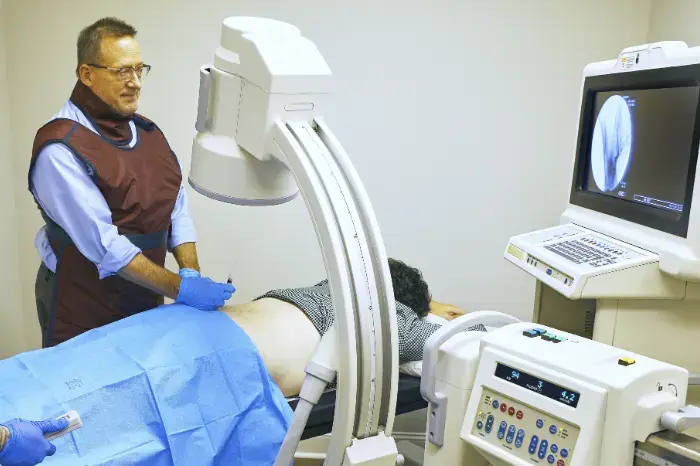
Why Live X-Ray Guidance Is Essential in the Spine
All low back PRP injections are performed with fluoroscopic guidance (live X-ray) by our board-certified medical doctors to ensure the platelets are delivered safely to the exact area of injury. The spine is where precise placement matters most, because of the small size of the facet joints, the unique, irregular angle of the SI joints, and the risks of injecting the wrong area. Spinal injections done without fluoroscopic guidance are not only a serious safety risk; it is essentially impossible to accurately inject these areas without live X-ray.
How the PRP Procedure Works
The Blood Draw
Professor Bansal's groundbreaking study demonstrated that a targeted dose of approximately 10 billion platelets in 8 mL of PRP is critical for achieving long-term clinical efficacy. A minimum of 120 mL of blood must be drawn to achieve the proper platelet counts. If that is not happening, you are not receiving high-dose PRP. Our nurse will draw your blood, then you will wait approximately 45 minutes for your PRP to be prepared.
Be sure to drink plenty of water the day of your PRP procedure to make the blood draw go more smoothly.
The Centrifuge
This is the second critical step to creating high-dose PRP. Higher dosing leads to better results. We believe in utilizing cutting-edge innovation to produce the best results for our patients. To create our high-dose PRP, our inventors created a desktop version of what blood banks and the American Red Cross use, and nobody knows how to generate high platelet counts for patients in need better than they do. Our nurses spend about 45 minutes processing your platelets by hand in between each spin in the centrifuge machine. You can be assured that the quality, safety, and effectiveness of our treatments are second to none. We are very proud of that.
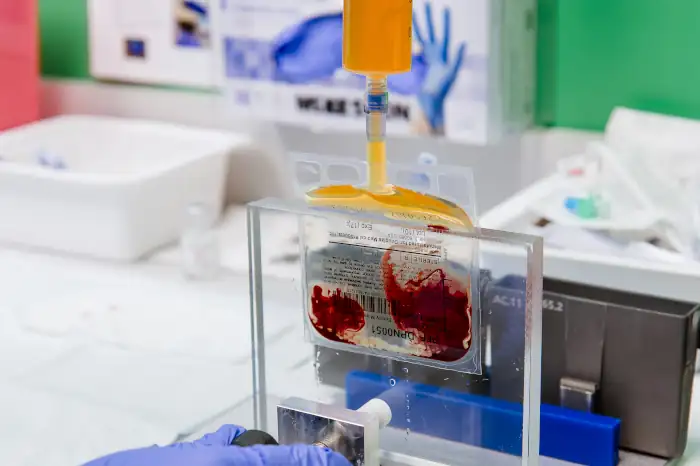
Our PRP centrifuge system produces a much higher level of platelets than Orthopedic and Physical Medicine and Rehabilitation (PM&R) clinics using easy-to-operate centrifuge machines that anyone can run by just pressing a button. The major flaw of these machines is that they are not capable of separating unwanted red blood cells when they are programmed to produce a higher platelet count. Too many red blood cells in a PRP injection is not outright toxic, but "red cell contamination" can increase post-injection pain and inflammation while lowering the treatment's overall effectiveness.
The NeoGenix Difference: Adding Autologous Exosomes to PRP = SuperShot® PRP
Most legitimate centrifuge machines require 2 spins: the first to separate the red blood cells and the second to separate the platelets from the plasma. After the second spin, most clinics simply throw that plasma away. Not at NeoGenix. We add the SuperShot® PRP solution to the remaining plasma and spin it in the centrifuge machine a 3rd time. In doing so, we are adding hundreds of billions of exosomes to your PRP. Exosomes are tiny messenger particles released by cells to help reduce joint inflammation and signal damaged low back tissues to repair themselves. In head-to-head lab testing with leading off-the-shelf exosome donor tissue products, SuperShot® PRP was shown to have 166 times more exosomes (see lab results).
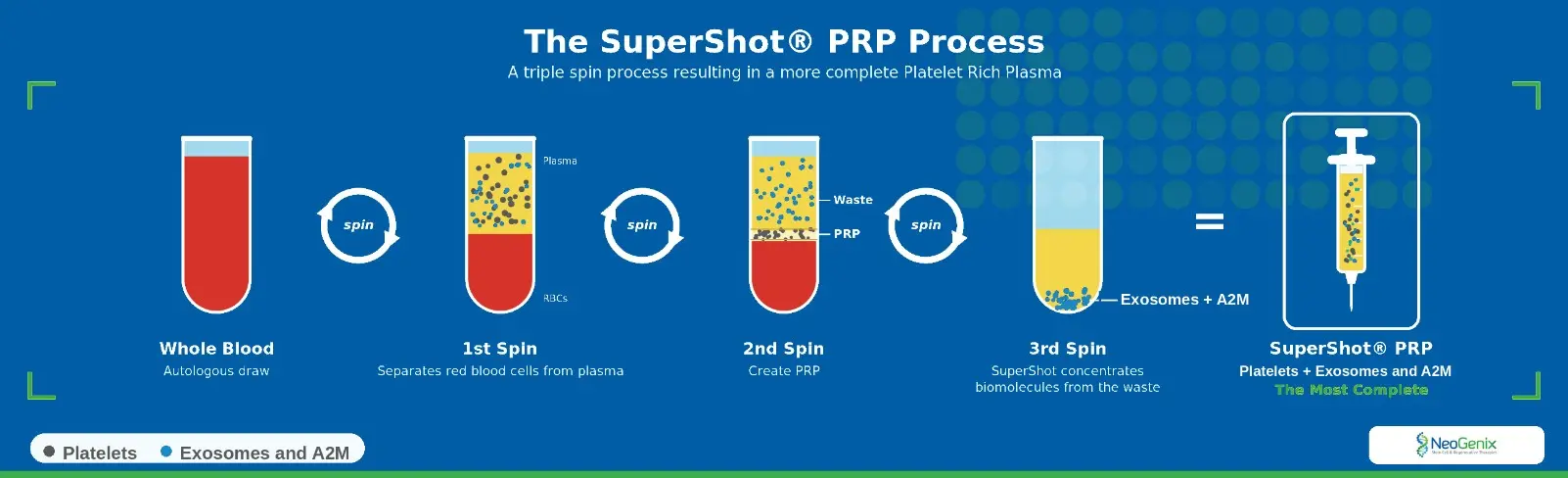
A 2-year study comparing SuperShot® PRP to regular PRP showed that SuperShot® PRP created significantly better patient outcomes with longer-lasting results (see the study).
Recovery and What to Expect
1 to 2 weeks after
Start a physical therapy or rehab program 1 to 2 weeks after your injection. PRP works on your low back joints, muscles, tendons, and ligaments internally. If you have muscle weakness or compensation issues around your low back, a rehab professional needs to correct them to maximize your results.
Treating the right low back conditions with PRP, we expect years of long-lasting relief.
When Does Low Back Pain Require Stem Cell Therapy Instead of PRP?
PRP is an excellent treatment option for mild to less moderate low back conditions. It is important to remember that PRP does not contain stem cells, only growth factors. For patients with moderate to severe low back pain, arthritis, and radicular symptoms, we recommend stem cell therapy to treat your low back to help heal damaged cartilage and tissue.
As long as your low back pain is not causing severe weakness in your legs or other concerning neurological symptoms, stem cell therapy may be able to prevent you from having low back surgery.
PRP vs. Cortisone and Epidurals
In the traditional medical model, cortisone and epidural injections are commonly the first options offered by spine doctors or PM&R pain doctors.
Cortisone and Epidurals
Cortisone shots have been well studied. They can provide some short-term relief by turning off your pain receptors and helping with inflammation. They are only masking the pain and are doing nothing to actually heal your injury. Long-term, repeated use of cortisone is shown to damage your joints, muscles, tendons and ligaments over time (see study).
PRP Therapy
Nowadays, almost every spine doctor or PM&R doctor offers some version of PRP. Unlike cortisone and epidurals, PRP can actually heal and repair the damaged cartilage and tissue in your low back.
Studies now show that PRP is safer and provides much better long-term results when compared to cortisone or epidural injections into your lumbar spine (see study).
| Feature | PRP Therapy | Cortisone and Epidural Injections |
|---|---|---|
| Cost to Patient | Low to moderate | Low |
| Cost to Insurance | None | Low |
| Tissue Regeneration | Yes | No |
| Natural Healing | Yes | No |
| Recovery Time | Less than a week | 1 to 2 days |
| Start to See Improvement | 3 to 6 weeks | Within a week |
| Duration of Improvement | Potentially years | Weeks to months |
| Complications and Risks | Highly unlikely | Causes joint degeneration |

David's Sciatica Went From a 7 to a 2 in 6 Weeks
After already successfully treating David's knee with PRP in early 2025, he came back to see me to treat his low back in August of 2025. He had mild to moderate low back pain and constant 7/10 sciatica pain that had lingered for the last few months. This time I did SuperShot® PRP into his bilateral L3-S1 facet joints and both of his SI joints. It only took him about 6 weeks for his pain to be reduced to 2/10, and now, over a year later, his back and sciatica are still doing great.
Dr. AltizerJames Altizer, M.D.
Individual results may vary.
Find Out If Low Back PRP Is Right for You
Bring your MRI or X-rays if you have them. A NeoGenix doctor will examine your back, review your history, and tell you honestly whether PRP, SuperShot® PRP or stem cell therapy is the right fit.
Mon to Thu 9am to 5pm · Fri 9am to 12pm
Low Back PRP FAQs
Does low back PRP work for a herniated disc?
Should I get low back PRP or an epidural steroid injection?
Is it normal for my back to hurt more at first?
How many low back treatments will I need?
How long does low back PRP last?
Does insurance cover spinal PRP?
What is the success rate of low back PRP?
Request Your FREE Consultation
Thank you for your interest in NeoGenix. For more information, or to schedule a FREE consultation, please call or text us at 704-727-6551 or simply fill out the form below and a NeoGenix team member will respond as soon as possible.
Our Stem Cell Treatment in Charlotte, NC is EFFECTIVE
- Based on thousands of stem cell and growth factor procedures performed by Dr. Altizer since January of 2016, over 94% of patients have subjectively, objectively, and through activities of daily living reported the procedure was successful.
- The success of the procedure was determined by the patient achieving at least a 50% or more overall improvement with lasting results.
- When asked after 1 year what their overall improvement was, patients have subjectively, objectively, and through activities of daily living reported an average overall improvement of between 83-84%.