
How Much Does Stem Cell Therapy Cost in Charlotte, NC?
The cost of PRP (platelet-rich plasma) and stem cell therapy in Charlotte depends on three things:
Which type of treatment you actually need (PRP vs a stem cell procedure), how many joints or areas are being treated, and how advanced your condition is. Insurance does not cover the injection procedure itself, though it often does cover much of the care around it, and NeoGenix offers financing through CareCredit and accepts HSA and FSA funds.
Because the right treatment is a medical decision rather than a menu item, we can only give price ranges over the phone. Treatment recommendations depend on:
Which procedure gets recommended also depends heavily on which part of the body is involved, because a shoulder and a lumbar spine are not the same problem. Stem cell therapy for shoulders and Stem cell therapy for back pain go into how the approach differs by area.
The general price range we tell people over the phone for PRP therapy, all the way up to stem cell therapy from your bone marrow aspirate and adipose(fat) tissue, is between $1,000-$7,500 to treat 1 area and between $700-$1,500 to treat each additional area. Your exact cost is confirmed in writing after a free consultation and hands-on exam with one of our board-certified physicians, before you commit to anything.
What Affects the Cost of Stem Cell and PRP Therapy
Two people can walk in with the same knee pain and leave with two very different treatment plans, and two different costs. Here’s what drives the difference:
Which type of cells or procedure is used.
How many areas or joints are treated.
The severity and complexity of your condition
Earlier-stage joint irritation, a partial tendon tear, and advanced degenerative change are three different problems. More advanced or more complex conditions generally call for a more involved procedure, a larger volume of cells, or a staged plan over time, all of which affect the cost.
The expertise behind the procedure
How cells are harvested and concentrated, and whether the injection is placed under real-time imaging guidance, are part of what you’re paying for. Processing equipment, ultrasound and fluoroscopy, and physician-performed injections all carry real cost, and they’re the difference between a treatment delivered precisely and one delivered approximately. There is nothing more important than choosing the right provider. The reason being is that there is no consensus playbook on how to administer PRP and stem cell therapy. It literally all comes down to experience and integrity.
If you already know which area is bothering you, our condition pages walk through how we approach each one: see how we treat pain in your knees, hips, back, shoulders, and more.
At NeoGenix, we are the industry leaders in regenerative medicine, with over a decade of medical practice devoted solely to performing these procedures. We offer no other services at our clinics besides PRP and stem cell therapy. Our Board-Certified Medical Doctors have treated over 6,000 patients with Regenerative Medicine, by far the most of any clinic in the Carolinas. Reach out to schedule your free consultation today!
The equipment behind the procedure.
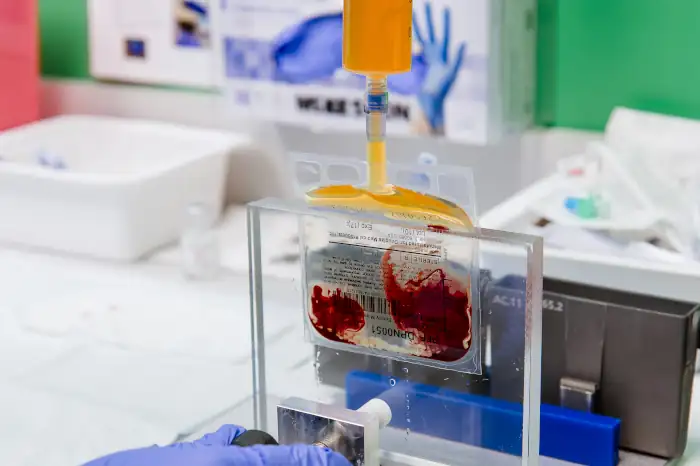
Our high-dose stem cell and PRP kits produce a much higher level of healing properties than Orthopedic and Physical Medicine and Rehabilitation (PM&R) clinics. Higher dosing leads to better results. We believe in utilizing cutting-edge innovation to produce the best results for our patients. To create our high-dose PRP, our inventors created a desktop version of what blood banks and the American Red Cross use, and nobody knows how to generate high platelet counts for patients in need better than they do. To achieve our high-dose stem cell counts, we worked directly with industry-leading inventors to beta test our bone marrow aspirate and adipose(fat) tissue collection and processing equipment to create higher cell counts than anyone in the industry. You can be assured that the quality, safety, and effectiveness of our treatments are second to none. We are very proud of that.
The Cost of PRP Therapy in Charlotte, NC
PRP costs less than a stem cell procedure, and the reason is straightforward: it’s a simpler procedure to perform. PRP starts with a blood draw. The sample is concentrated in-office to isolate the platelet-rich portion, and that concentrate is injected into the injured area under imaging guidance. It’s a single visit, minimally invasive, and typically the first option a physician considers for milder or earlier-stage problems: early joint irritation, tendon and ligament injuries, and pain that hasn’t yet progressed to significant structural change.
Not all PRP is prepared the same. PRP has become commonplace in Orthopedic and PM&R clinics. However, not all PRP is created equal, and that is why there is such a price difference between clinics. If you start with a low dose of blood and simply put it in an easy-to-use, cheap centrifuge machine where you just push a button, you are not creating the high-dose PRP that is necessary to facilitate the healing process in an injured area.
Our doctors utilize the ONLY FDA-cleared (510K) 3-spin PRP centrifuge system, allowing billions of autologous exosomes and A2M healing properties to be added to our high-dose PRP that other clinics just simply throw away. Data shows that high platelet counts with exosomes lead to better patient outcomes; see the Study here.
Cost of PRP treatment at NeoGenix
Our regular high-dose PRP treatments and our SuperShot PRP treatments with autologous exosomes range between $1,000-$2,000 to treat one area. We only charge $700 for each additional area, as we have already opened our FDA-cleared (510k) sterile kit to treat your first area. Simply put, the hard cost to perform our PRP procedures is often the same cost an orthopedic clinic will charge you for a PRP injection because they are using a much cheaper and lower-quality version of PRP. Providing you with the highest platelet count possible is our #1 goal, as it will lead to better, long-lasting results
The Cost of Stem Cell Therapy in Charlotte, NC
A stem cell procedure is a bigger undertaking. Cells are harvested from your own bone marrow aspirate or adipose(fat) tissue (a separate procedural step performed under imaging guidance and local anesthetic), then processed and injected. More steps, more equipment, and more physician time mean a higher cost. That’s generally the direction a physician leans for more advanced conditions, where there’s more degeneration or damage to address and where a simpler approach may not be enough.
Stem cell therapy vs multiple PRP injections. While PRP is incredibly successful for mild to less moderate conditions, it rarely provides long-lasting results for moderate to severe conditions. Many clinics will stack 3-4 PRP injections together over the course of 4-6 months to treat moderate to severe conditions; we don’t.
If your condition warrants more powerful treatment, the answer is not multiple PRP injections; the answer is stem cell therapy.
There are no stem cells in PRP, only growth factors. Stem cells are necessary to help facilitate the healing process for moderate to severe arthritis and more complex tears such as a rotator cuff injury. NeoGenix ONLY offers autologous stem cells from your own Bone Marrow Aspirate and Adipose (fat) Tissue. Our collection methods achieve a high concentration of colony forming unit-fibroblasts (CFU-f). High CFU-f counts mean more mesenchymal stem cells (MSCs), which lead to better patient outcomes.
Cost of stem cell therapy at NeoGenix
Our stem cell treatments range in cost between $4,000-$7,500 to treat one area. An official cost will be provided at your free consultation after our physical examination and review of your imaging determine the severity of your condition. We only charge $1,500 for each additional area, as we have already opened our FDA-cleared (510k) sterile kit to treat your first area. Providing you with the highest CFU-f counts possible is our #1 goal, as it will lead to better, long-lasting results. Included in the cost of our stem cell procedures is a booster injection of SuperShot PRP 2-3 months after the stem cell procedure is performed. Think of that as adding fertilizer to the stem cells a few months down the road to help strengthen the healing process.
How This Compares to Other Treatment Paths
Regenerative medicine works. The field of regenerative medicine is rapidly growing in America and all over the world. Thousands of published studies have already been done, and more are becoming available every day, such as this one from Professor Bansal. The consensus, based on all currently available data, is that PRP and stem cell therapy works and works extremely well when done ethically by the right provider using equipment that produces high platelet and stem cell counts.
Studies have now proven that regenerative medicine treatments can alter the natural history of degenerative arthritis by actually slowing down how fast arthritis progresses over time. No other medical or surgical treatment has ever been shown to do this. This is a revolutionary, industry-changing result.
The orthopedic model is now outdated. The orthopedic standard of care has always been cortisone shots, medications, and gel shots to mask the pain until the arthritic joint finally deteriorates to the point that joint replacement is the only option. That treatment model is now outdated and no longer necessary.
You are no longer destined to get the same joint replacements your parents and grandparents did. You are living at a time in history when, for the first time, science and technology are available to preserve your joints naturally with PRP and stem cell therapy.
This is not the result that most orthopedic surgeons want to talk about, and many of them downplay the results or denigrate the entire field. Now, with PRP and stem cell treatments, we can not only alleviate joint pain naturally, but we can also, in many cases, actually delay and even prevent joint replacement surgery. We are not against surgery, as we typically refer 8-10 consultations a month for surgery because we cannot help them. We believe it should be the final step in your pursuit to alleviate your joint pain or heal your injury.
Which medical model do you want to live in?
After meeting with one of our Medical Doctors and once you are judged to be an acceptable candidate for our state-of-the-art regenerative medicine treatments, you have one basic decision to make, and that is which medical model do you want to be a part of:
The first one is usually covered by insurance, and you may have little to no out-of-pocket expense. If you have Medicare or a Medicare Advantage plan OR in many cases it may cost thousands of dollars based on high deductibles.
The second is not covered by insurance, and we understand that it may carry a significant expense to you. You only have 2 knees, 2 hips, 2 shoulders, etc. Artificial replacements will never be as good as what God gave you, and they won’t last as long, either. In decades to come, the treatments we offer at NeoGenix will be the standard of care in all orthopedic offices.
We are way ahead of the curve, and you can be too if you choose the up-to-date model of treatment. The choice is always yours, and we will never at any point during your consultation try to hard sell you or make any unrealistic guarantees.
| NeoGenix Stem Cell and Regenerative Therapies | Surgery | Medications | Cortisone Injections | Hyaluronic Acid | |
|---|---|---|---|---|---|
| Cost to Patient | Moderate | High | Low to Moderate | Low | Low |
| Cost to Insurance | None | High | Low to Moderate | Low | Low |
| Tissue Regeneration | Yes | No | No | No | No |
| Natural Healing | Yes | No | No | No | No |
| Recovery Time | Less than a week | Months | None | 1-2 days | 1-2 Days |
| Duration of Improvement | Several years | Months to years | Requires monthly prescriptions | Weeks to months | 4-6 months |
| Complications | Highly unlikely | Potentially life threatening | Extremely Addictive | Causes joint degeneration | Allergic reactions |
Insurance, Financing, and Payment Options
Insurance does not cover PRP or stem cell therapy itself. That’s true across the board for these procedures, not a quirk of our practice.
Bring your questions about payment to the consultation; it’s part of what that visit is for.
What insurance often does cover is a meaningful share of the care surrounding the procedure:
CareCredit financing. NeoGenix accepts CareCredit, which lets you spread payment over time interest free rather than covering the full amount up front. Our staff can walk you through the application.
HSA and FSA funds. We accept health savings accounts and flexible spending account payments, which lets many patients use pre-tax dollars toward treatment.
Why the Provider You Choose Matters
Cost only means something in relation to what you’re getting. Here’s what defines how NeoGenix performs these procedures:
We use only your own cells.
Every stem cell procedure at NeoGenix uses autologous tissue. Cells harvested from your own bone marrow or your own fat tissue, on the day of your procedure. We do not use donor tissue, frozen products, or pre-packaged off-the-shelf cell products of any kind. What goes back into your joint came out of your body that day. Unfortunately, there are many bad apples in regenerative medicine, just like any field. There are clinics practicing even in our local area that are offering substandard “PRP” and even illegal off-the-shelf “stem cell” products being administered by poorly qualified personnel.
A board-certified physician performs every injection, under imaging guidance.
Every injection is placed by a board-certified physician using real-time ultrasound or fluoroscopic guidance, so the physician can see exactly where the needle is and exactly where the cells are going. We do not perform these injections by feel or by surface landmarks alone. Learn More about the Doctors.
This is what we do.
NeoGenix has focused exclusively on PRP and stem cell therapy for more than a decade, not a service line added alongside something else. PM&R doctors see regenerative medicine as a high-end cash service to enhance the revenue of their normal everyday practice of medications, cortisone shots, and interventional pain procedures. They treat you based on your insurance coverage. Be aware of how experienced these clinics really are with regenerative medicine, often making claims like they have treated over 30,000 patients, when in reality 99% of those procedures were harmful steroid injections. Even Chiropractors in states like South Carolina are selling PRP and illegal off-the-shelf “stem cell” treatments to patients, then hiring a nurse or a mid-level provider to simply show up and administer the injections with no medical oversight or diagnosis.
Patients trust the experience enough to say so publicly.
NeoGenix holds a 5.0-star rating across 240+ Google reviews from Charlotte-area patients, one of the largest bodies of patient feedback of any regenerative medicine practice in the country. Based on 6,000+ PRP and stem cell procedures performed by our experienced physicians since January of 2016, over 94% of patients have subjectively, objectively, and through activities of daily living reported the procedure was successful. The success of the procedure was determined by the patient achieving at least a 50% or more overall improvement with lasting results. When asked after 1 year what their overall improvement was, patients have subjectively, objectively, and through activities of daily living reported an average overall improvement of between 83-84%.
Does PRP and Stem Cell Therapy Actually Work?
Your body can heal itself. PRP and stem cell therapy, often referred to as regenerative medicine, is the process of using the healing properties of your own body to heal and repair damaged cartilage and tissue.
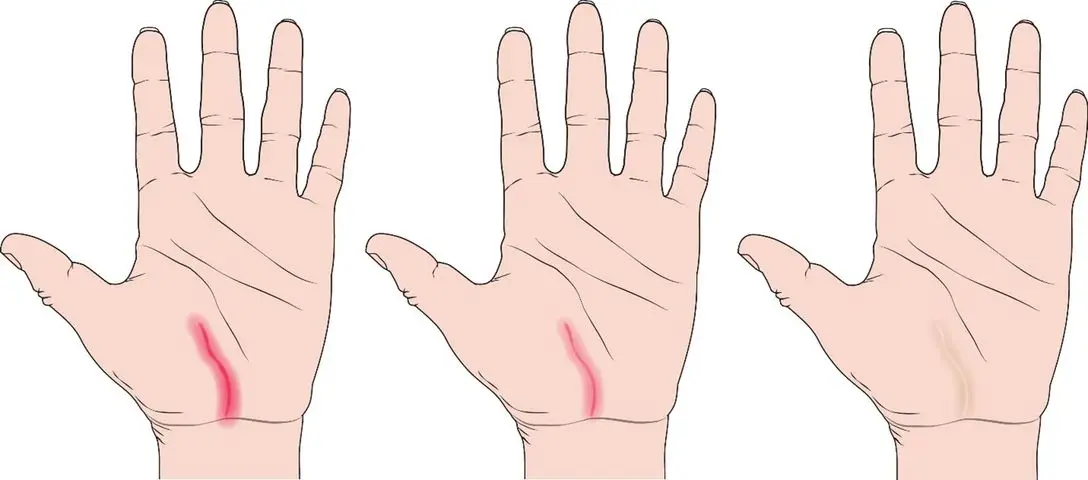
Let’s use an analogy to help explain this further. Let’s say you cut your hand. Typical treatment is to simply put a Band-Aid on the cut and let the cut heal. When your body is injured and there is a good vascular blood supply going to the injured area, your body will send platelets and stem cells to the injured area. First, a scab forms and eventually turns into a scar. Over time, the scar will fade away as well. This is your body healing itself with platelets and stem cells.
Our Medical Doctors are assisting your body. So why won’t our joints heal themselves when cartilage starts to break down over time? The simple reason is our joints do not have adequate circulation. There is no artery inside any joint. PRP and stem cell therapy is simply taking the healing properties from your blood, fat tissue, and/or bone marrow aspirate, concentrating the healing properties in a centrifuge machine, and injecting them back into the injured area. What happens then? The damaged cartilage and tissue in your joints will start to heal and repair like the cut on your hand. PRP and Stem Cell Therapy is taking the healing properties from your own body and moving them to an area of your body that cannot self-heal.
Our bodies all respond differently to treatment. The majority of our patients experience meaningful pain relief and real improvement in function, and for a substantial number, that relief holds up over years of time. Patients tell us about walking further, sleeping through the night, getting back on the golf course or the tennis court, and getting through a workday without thinking about their joint. Those outcomes are the reason we do this work.
How you respond depends on your condition, how advanced it is, your overall health, how well you follow through on recovery, and factors nobody can fully predict in advance. Most patients get a great deal of relief. Some get moderate relief. Less than 10% don’t get the result they hoped for. Any provider who tells you otherwise is selling rather than treating. We don’t guarantee outcomes, and we don’t use pressure to get you to decide. At your consultation, a physician will tell you honestly whether you look like a good candidate, and if you don’t, we’ll say so.
Is Stem Cell Therapy FDA Approved?
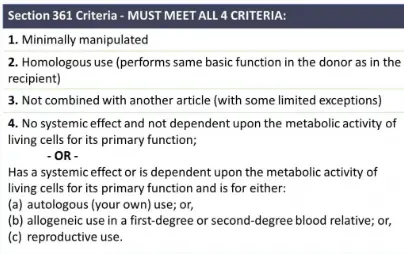
Autologous vs Allogeneic cells. Live cells are allowed by the FDA under 2 sections of the Public Health Service Act (Section 351 and 361), which provides the authority for the FDA to establish regulatory requirements for marketing traditional biologics and human cells, tissues, and cellular and tissue-based products. These two pathways (Section 351 and 361) differ markedly in terms of the time, effort, and expense required to bring these products to market in the U.S. One is the simple 361 registration, and the other is the complex 351 cell-drug approval. We only use your own stem cells (autologous), which we use carefully so that we are compliant under Section 361 of the Public Health Service Act and the same-day surgical exception. However, our procedures are considered experimental by the FDA and by insurance companies.
As of 6/1/21, the FDA ended the grace period for clinics to use unregulated donor tissue products. These allogeneic growth factor products (that come from other people, like placental, umbilical cord, amniotic, and exosome products) are under heavy scrutiny by the FDA right now. In fact, many labs that sell these donor tissue products to clinics have ceased operations.
What has FDA approved at this point?
The only PRP and stem cell treatment currently FDA-approved involves the use of bone marrow transplants for treating leukemia. Eventual FDA approval for autologous PRP and stem cell treatments for other indications like degenerative arthritis is highly likely, in our opinion; we just do not know when.
The equipment NeoGenix uses to obtain and process autologous PRP and stem cells is FDA-cleared (510k) for that use, and NeoGenix is careful to abide by all FDA regulations pertaining to PRP and stem cell treatments.
Frequently Asked Questions
How much does one PRP or stem cell session cost?
There’s no single price, because there’s no single procedure. Cost depends on whether you’re receiving PRP or a stem cell procedure, how many joints or areas are treated, and how advanced your condition is. We give you an exact figure in writing after a free consultation and physical exam.
How long do PRP and stem cell injections last?
It varies by patient and by condition. Most of our patients experience years of long-lasting relief; we just can’t put an exact timetable on it as everyone’s body responds differently to treatment. Your condition’s severity, your overall health, and how closely you follow your recovery plan all play a role. Our Medical Doctors can give you realistic expectations for your specific situation at your free consultation.
Are PRP and stem cell therapy worth the cost?
That’s a personal calculation. What we can tell you is that the patients who feel best about the decision are the ones who went in with clear expectations, were good candidates on exam, and followed through on recovery. The free consultation exists so you can make that call with real information.
Does insurance cover stem cell or PRP therapy?
Insurance does not cover the procedure itself. It frequently does cover the surrounding care: your office visits, ultrasound exams, preparatory injections where appropriate, bracing, and post-treatment physical therapy. For the procedure, NeoGenix offers CareCredit financing and accepts HSA and FSA funds.
Where do the stem cells come from?
Your own body. Every stem cell procedure at NeoGenix uses tissue harvested on the day of treatment, from either your bone marrow aspirate or your own adipose(fat) tissue. We do not use donor tissue, frozen cells, or off-the-shelf cell products that have been deemed illegal by the FDA.
Is stem cell therapy FDA approved?
The only PRP and stem cell treatment currently FDA-approved involves the use of bone marrow transplants for treating leukemia. Eventual FDA approval for autologous PRP and stem cell treatments for other indications like degenerative arthritis is highly likely in our opinion, we just do not know when. The equipment NeoGenix uses to obtain and process autologous PRP and stem cells is FDA-cleared (510k) for that use, and NeoGenix is careful to abide by all FDA regulations pertaining to PRP and stem cell treatments.
What’s the difference between PRP and stem cell therapy?
PRP uses your own blood: a sample is drawn, concentrated in-office to isolate the platelet-rich portion, and injected into the area being treated. A stem cell procedure uses cells harvested from your own bone marrow aspirate or adipose (fat) tissue, which requires an additional procedural step under imaging guidance and local anesthetic before the cells are processed and injected. Both are performed in-office in a single visit, and both use only your own tissue. Bone marrow aspirate and adipose(fat) tissue are rich in growth factors and stem cells. PRP only has growth factors. Which one a physician recommends depends on what the exam and imaging show, not on preference.
How many treatments or injections will I need?
There’s no standard number, and anyone who gives you one before examining you is guessing. Some patients are treated in a single visit; others are placed on a treatment plan with follow-up injections spaced out over time, which is more common with more advanced or more complex conditions. Your physician will lay out the expected plan at your consultation, in writing, before you commit to anything.
Can I go back to work the same day?
These are in-office, minimally invasive procedures, and patients walk out on their own the same day rather than being admitted anywhere. Many people with desk-based or light-duty jobs return to work the same day or the next; physically demanding work, heavy lifting, and strenuous activity usually need to wait longer. You’ll be given specific activity restrictions for your procedure and your treated area before you leave, from your physician.
What conditions can PRP and stem cell therapy treat?
NeoGenix works exclusively in orthopedic and musculoskeletal pain: most often joint pain related to degenerative change in the knees, hips, shoulders and spine, along with muscle, tendon, and ligament injuries. We do not offer these procedures for conditions outside that scope. Whether you’re a candidate is a clinical determination made after a hands-on exam and a review of your imaging and treatment history. Some people who come in are candidates, some are better served by another path, and we’ll tell you which.
Are there risks or side effects?
Every medical procedure carries risk, and these are no exception. The most common effects are temporary: soreness, swelling, bruising or a short-term increase in pain at the injection or harvest site, typically settling over a period of days. There is always a risk of infection when you puncture the skin, however, we have never seen one in over 6000 procedures performed. Your physician will go through the specific risks for your procedure with you during the informed-consent conversation before anything is scheduled.
Get a Real Answer About Your Joint and Your Cost
Schedule your free consultation with a board-certified physician who will examine the joint, review your imaging, tell you honestly whether you’re a good candidate, and give you an exact cost in writing for the treatment you actually need.No pressure. No obligation. If the procedure isn’t right for you, we’ll tell you.
The success of the procedure was determined by the patient achieving at least a 50% or more overall improvement with lasting results.
When asked after 1 year what their overall improvement was, patients have subjectively, objectively, and through activities of daily living reported an average overall improvement of between 83-84%.
Our Stem Cell Treatment in Charlotte, NC is EFFECTIVE
- Based on thousands of stem cell and growth factor procedures performed by Dr. Altizer since January of 2016, over 94% of patients have subjectively, objectively, and through activities of daily living reported the procedure was successful.
- The success of the procedure was determined by the patient achieving at least a 50% or more overall improvement with lasting results.
- When asked after 1 year what their overall improvement was, patients have subjectively, objectively, and through activities of daily living reported an average overall improvement of between 83-84%.
Request Your FREE Consultation
Thank you for your interest in NeoGenix. For more information, or to schedule a FREE consultation, please call or text us at 704-727-6551 or simply fill out the form below and a NeoGenix team member will respond as soon as possible.