
PRP Therapy for Elbow Pain in Charlotte, NC
Non-surgical, ultrasound-guided PRP injections for tennis elbow, golfer's elbow, elbow tendonitis and arthritis, performed by NeoGenix's board-certified physicians in Charlotte.
Why patients choose NeoGenix
The Elbow PRP Therapy Process
- Source: Autologous (from you)
- Elbow Conditions We Treat: Arthritis, golfer's elbow, tennis elbow, and tendonitis
- Stage of Arthritis or Injury: Mild to less moderate
Platelet-rich plasma (PRP) is among the fastest-growing areas in regenerative medicine. It utilizes the body's own healing components to boost tissue healing. PRP therapy uses a large number of autologous platelets in the patient's plasma. The platelets are injected into or directly applied to the tissue.
Elbow PRP From a Clinic That Only Does Regenerative Medicine
PRP (Platelet-Rich Plasma) or SuperShot® PRP treatment is an effective option when elbow pain comes from mild to moderate injury or degeneration of the elbow joints, tendons, and ligaments. More moderate to severe conditions may be better served by bone marrow treatment.
Every elbow treatment at NeoGenix is performed under guided imaging by a board-certified doctor, and only after a NeoGenix doctor has examined you and reviewed your imaging and medical history to confirm you are a good candidate. We focus only on regenerative medicine; PRP is never an add-on to a clinic that specializes in something else.
What Elbow Conditions Does PRP Treat?
Elbow Arthritis
Causes pain, stiffness, and a reduced range of motion when the cartilage inside the joint wears down or becomes inflamed.
Tennis Elbow or Pickleball Elbow
Medically called lateral epicondylitis, an overuse injury that causes pain and degeneration in the tendons connecting your forearm muscles to the outside of your elbow.
Golfer's Elbow
Medically called medial epicondylitis, an overuse injury that causes pain and tenderness on the inside of the elbow where forearm tendons attach to the bone.
Elbow Tendonitis
An inflammation or breakdown of the tendons in the elbow caused by repetitive arm, wrist, or hand movements.
Ulnar Nerve Irritation or Cubital Tunnel Syndrome
Happens when the ulnar nerve (the nerve that runs through the inside of your elbow and down to your ring and pinky fingers) becomes squeezed or irritated, causing numbness, tingling and hand weakness.
Elbow Sprains and Strains
An elbow sprain is an injury to a ligament (tissue connecting bones), while an elbow strain is an injury to a muscle or tendon (tissue connecting muscle to bone).
Tennis and Golfer's Elbow Are Very Different Conditions
Most cases of tennis and golfer's elbow come from everyday work or hobbies (like painting, typing, or lifting) rather than sports. Physical therapy, rest, medications, and cortisone shots are common treatment options for both of these conditions.
Tennis Elbow
Lateral epicondylitis: pain and degeneration in the tendons connecting your forearm muscles to the outside of your elbow.
- Worse when lifting
- Worse when extending the wrist
- Worse when shaking hands
Golfer's Elbow
Medial epicondylitis: pain and tenderness on the inside of the elbow where forearm tendons attach to the bone.
- Worse when bending the wrist forward
- Worse when squeezing
- Worse when gripping hard
Why PRP for Tennis and Golfer's Elbow?
PRP therapy for elbow pain is one of the best non-surgical options for conditions like tennis and golfer's elbow, and tendon conditions of the elbow are among the most researched uses of PRP. Elbow pain can be very stubborn. Cortisone shots only provide temporary relief and in the long term do nothing to repair damaged tendon, and research suggests repeated steroid use may lead to worse long-term outcomes in tendon conditions. By injecting high-dose PRP directly into the damaged tendon under ultrasound guidance, we aim to support the body's own repair of the tissue rather than mask the symptoms with addictive medications or harmful steroid injections.
How the PRP Procedure Works
The Blood Draw
Professor Bansal's groundbreaking study demonstrated that a targeted dose of approximately 10 billion platelets in 8 mL of PRP is critical for achieving long-term clinical efficacy. A minimum of 120 mL of blood must be drawn to achieve the proper platelet counts. If that is not happening, you are not receiving high-dose PRP. Our nurse will draw your blood, then you will wait approximately 45 minutes for your PRP to be prepared.
Be sure to drink plenty of water the day of your PRP procedure to make the blood draw go more smoothly.
The Centrifuge
This is the second critical step to creating high-dose PRP. Higher dosing leads to better results. We believe in utilizing cutting-edge innovation to produce the best results for our patients. To create our high-dose PRP, our inventors created a desktop version of what blood banks and the American Red Cross use, and nobody knows how to generate high platelet counts for patients in need better than they do. Our nurses spend about 45 minutes processing your platelets by hand in between each spin in the centrifuge machine. You can be assured that the quality, safety, and effectiveness of our treatments are second to none. We are very proud of that.
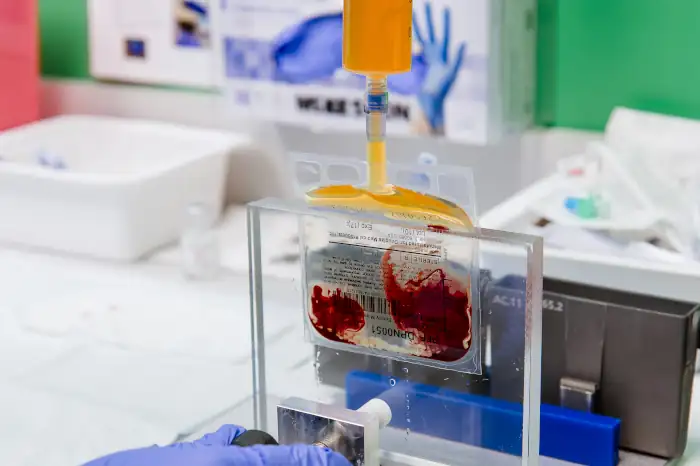
Our PRP centrifuge system produces a much higher level of platelets than Orthopedic and Physical Medicine and Rehabilitation (PM&R) clinics using easy-to-operate centrifuge machines that anyone can run by just pressing a button. The major flaw of these machines is that they are not capable of separating unwanted red blood cells when they are programmed to produce a higher platelet count. Too many red blood cells in a PRP injection is not outright toxic, but "red cell contamination" can increase post-injection pain and inflammation while lowering the treatment's overall effectiveness.
The NeoGenix Difference: Adding Autologous Exosomes to PRP = SuperShot® PRP
Most legitimate centrifuge machines require 2 spins: the first to separate the red blood cells and the second to separate the platelets from the plasma. After the second spin, most clinics simply throw that plasma away. Not at NeoGenix. We add the SuperShot® PRP solution to the remaining plasma and spin it in the centrifuge machine a 3rd time. In doing so, we are adding hundreds of billions of exosomes to your PRP. Exosomes are tiny messenger particles released by cells to help reduce joint inflammation and signal damaged elbow tissues to repair themselves. In head-to-head lab testing with leading off-the-shelf exosome donor tissue products, SuperShot® PRP was shown to have 166 times more exosomes (see lab results).
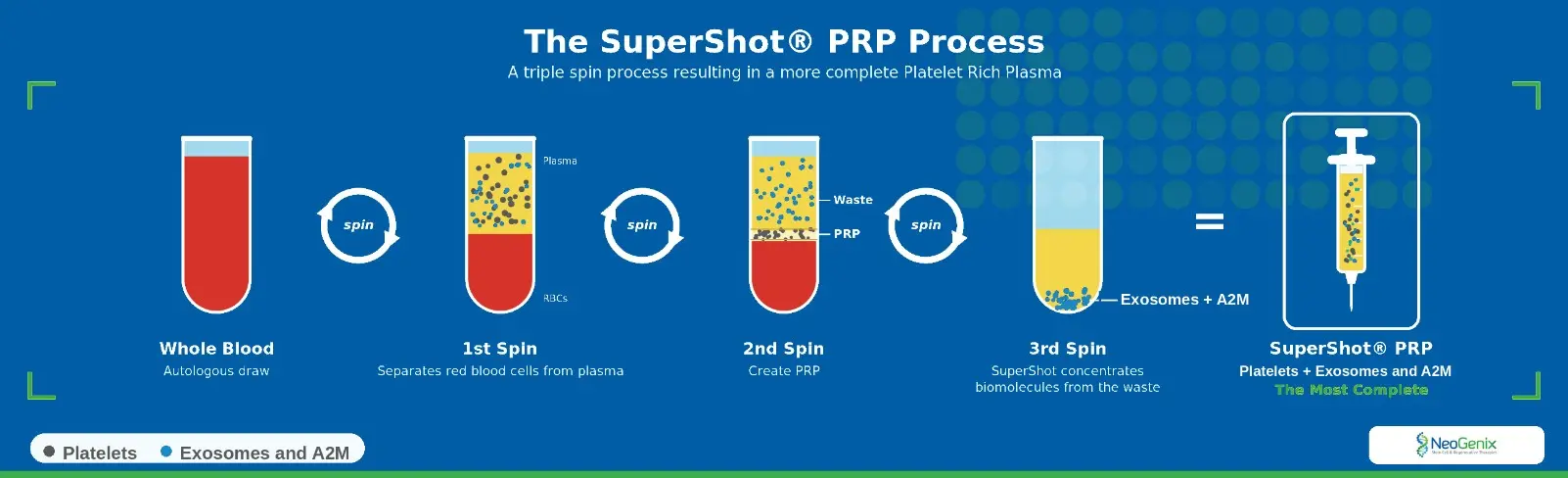
A 2-year study comparing SuperShot® PRP to regular PRP showed that SuperShot® PRP created significantly better patient outcomes with longer-lasting results (see the study).
Why Image-Guided Placement Matters With Elbows
All PRP injections are performed under ultrasound guidance by our board-certified medical doctors to ensure the platelets are delivered safely to the exact area of injury. Nothing is ever done by feel. Elbow tendons are small, layered and sit close to the skin, so a few millimeters decides whether the injection lands in the right tissue.
Recovery From an Elbow PRP Injection
a few weeks
After the initial soreness, we typically want you to relax for a few weeks before resuming repetitive motion activities.
1 to 2 weeks after
Physical therapy or a rehab protocol 1 to 2 weeks after your injection enhances the results. PRP helps heal the elbow joint and tendons; if you have muscle weakness or compensation issues around your elbow, a rehab professional must correct those biomechanical limitations to maximize your results.
The only potential risk of an elbow PRP injection is infection, and we have never seen one in over 6,000 regenerative medicine procedures.
PRP vs. Cortisone for Elbow Pain
In the traditional medical model, cortisone injections are commonly the first options offered by Orthopedic doctors or PM&R pain doctors.
Cortisone Shots
Cortisone shots have been well studied. They can provide some short-term relief by turning off your pain receptors and helping with inflammation. They are only masking the pain and are doing nothing to actually heal your injury. Long-term, repeated use of cortisone is shown to damage your joints, muscles, tendons and ligaments over time (see study).
PRP Therapy
Nowadays, almost every Orthopedic doctor or PM&R doctor offers some version of PRP. Unlike cortisone, PRP can actually heal and repair the damaged cartilage and tissue in your elbow.
Studies now show that PRP is safer and provides much better long-term results when compared to cortisone shots into the elbow (see study).
| Feature | PRP Therapy | Cortisone Injections |
|---|---|---|
| Cost to Patient | Low to moderate | Low |
| Cost to Insurance | None | Low |
| Tissue Regeneration | Yes | No |
| Natural Healing | Yes | No |
| Recovery Time | Less than a week | 1 to 2 days |
| Start to See Improvement | 3 to 6 weeks | Within a week |
| Duration of Improvement | Potentially years | Weeks to months |
| Complications and Risks | Highly unlikely | Causes joint and tendon degeneration |
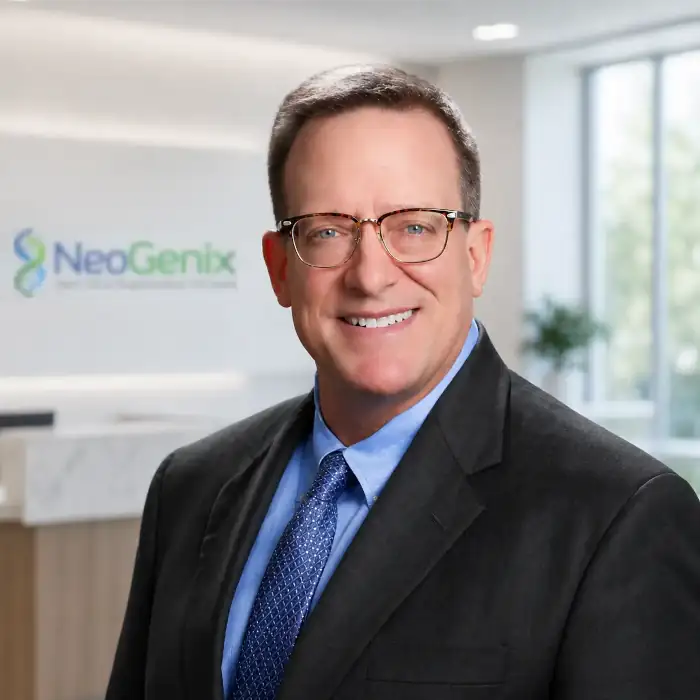
Robert Says We Fixed His Elbows
In May of 2025, I treated Robert for bilateral tennis elbow and golfer's elbow on his right arm. He had already tried shockwave and laser therapy. Elbows can be stubborn, so we typically always inject them twice with SuperShot® PRP a few months apart. These are also not the most comfortable injections, and Robert certainly had some discomfort the first few days after each injection. Almost a year and a half later, he is incredibly pleased that we were able to “fix his elbows,” in his own words.
Dr. AltizerJames Altizer, M.D.
Individual results may vary.
Find Out If Elbow PRP Is Right for You
Tell us what aggravates your elbow: gripping, lifting, your swing. A NeoGenix doctor will examine it, review your history, and tell you honestly whether PRP, SuperShot® PRP or stem cell therapy is the right fit.
Mon to Thu 9am to 5pm · Fri 9am to 12pm
Elbow PRP FAQs
Does PRP really work in elbows?
What is the downside of PRP injections?
How long is recovery from PRP for tennis elbow?
Is PRP worth it for tendon repair?
Is nerve damage a possible side effect?
Does insurance cover elbow PRP?
What is the success rate of elbow PRP?
Request Your FREE Consultation
Thank you for your interest in NeoGenix. For more information, or to schedule a FREE consultation, please call or text us at 704-727-6551 or simply fill out the form below and a NeoGenix team member will respond as soon as possible.
Our Stem Cell Treatment in Charlotte, NC is EFFECTIVE
- Based on thousands of stem cell and growth factor procedures performed by Dr. Altizer since January of 2016, over 94% of patients have subjectively, objectively, and through activities of daily living reported the procedure was successful.
- The success of the procedure was determined by the patient achieving at least a 50% or more overall improvement with lasting results.
- When asked after 1 year what their overall improvement was, patients have subjectively, objectively, and through activities of daily living reported an average overall improvement of between 83-84%.